
A University of Miami political scientist is paying Asian American and Pacific Islander (AAPI) residents of San Francisco, St. Paul, Detroit, and Asheville $75 to sit for anonymous, 45-60 minute Zoom interviews about local reparations initiatives under consideration in their cities. The recruitment flyer, circulated by research assistant Jessica Ma, names Dr. Matthew Nelsen, an Associate Professor of Political Science at the University of Miami, as the study’s lead.
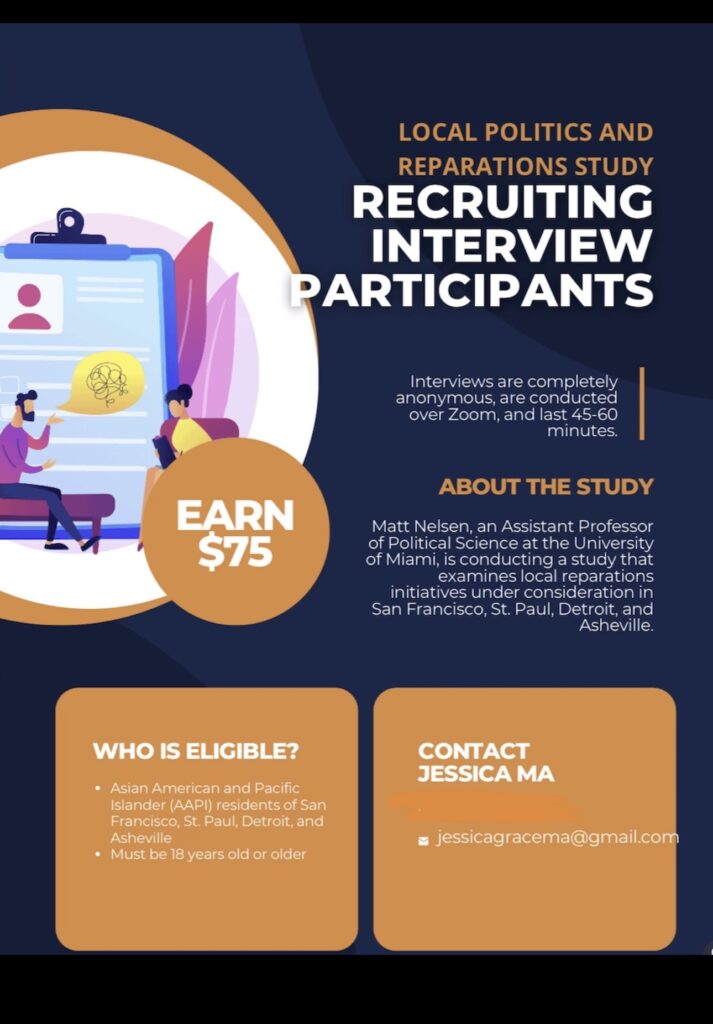
Given the well-documented history of Asian American plaintiffs being recruited to dismantle race-conscious policy in court, that flyer deserves scrutiny. Here’s what the public record actually shows about who’s behind this AAPI reparations study, why it exists, and the questions a critical reporter might be asking.
Who Is Matthew Nelsen?
Nelsen is not a newcomer to reparations research. He co-authored “The Politics of Expedience: Evanston, Illinois, and the Fight for Reparations” with Monique Newton, published in RSF: The Russell Sage Foundation Journal of the Social Sciences in June 2024. That peer-reviewed study examined how Evanston’s city council began distributing $25,000 housing grants to Black residents in March 2021.
The two researchers followed that with a related paper, “Forty Acres and a Mule: Symbolic Politics and the Pursuit for Black Reparations in the United States,” in Perspectives on Politics. Both papers treat reparations as a legitimate policy response to material and symbolic racial harm, a framing that runs counter to a sabotage motive.
The New AAPI Reparations Study, Explained
This AAPI reparations study is funded by a Russell Sage Foundation research grant titled “Forty Acres and a Mule: Local Reparations Policies in Comparative Perspective.” According to the foundation’s own project summary, Nelsen aims to examine how residents in San Francisco, St. Paul, Detroit, and Asheville understand the reparations policies their cities are actively pursuing.
Russell Sage is a century-old social science research foundation, not a legal advocacy or litigation-funding organization. That distinction matters, because it separates this project structurally from the legal campaigns discussed below.
Why This Raises Legitimate Flags
The concern isn’t paranoid, it’s pattern-matched to real, documented tactics. Legal activist Edward Blum has openly admitted recruiting Asian American plaintiffs specifically to attack affirmative action, telling audiences in 2015, “I needed Asian plaintiffs,” before building the Students for Fair Admissions cases against Harvard and UNC.
Legal scholars have a name for this maneuver: the “bait-and-switch.” Asian American grievances over college admissions get deliberately conflated with a broader assault on race-conscious policy. That conflation is then weaponized in court to roll back protections for all groups. Given that history, any study soliciting AAPI opinion on a Black-specific policy deserves a hard look at funding, methodology, and intended use.
What the Research Actually Shows
The available evidence points away from a sabotage narrative and toward genuine coalition-building research. A Washington Post analysis of California’s reparations debate found Asian Americans and Latinos were more likely to support reparations for Black Americans than commonly assumed.
Separately, peer-reviewed research published in PMC found that reminding Asian Americans of Japanese American WWII incarceration and redress increased their support for Black reparations, a shared-history solidarity effect researchers are actively working to understand. Japanese American organizations have echoed that solidarity directly: 76 JA and Asian American groups formally called for a presidential commission on Black reparations in 2023.
Questions Nelsen’s Team Should Answer
I’d expect there to be questions for Nelsen’s team on the following:
- Downstream use: Will findings be used by city councils to justify narrowing or slowing reparations proposals if opposition surfaces, or is the research purely descriptive?
- Full funding disclosure: Beyond Russell Sage, are there any additional funders tied to anti-affirmative-action or anti-DEI legal networks?
- Interview framing: Are questions posed neutrally, or do they prime scarcity or zero-sum framing between racial groups?
- Study design rationale: Why interview AAPI residents in isolation rather than surveying all racial groups together, as most other reparations opinion research does?
- Data transparency: Will raw transcripts be publicly available, or only the researchers’ interpretive conclusions?
5 Key Takeaways
- The study is peer-reviewed academic research, not litigation. It’s funded by the Russell Sage Foundation and builds directly on Nelsen’s published Evanston work.
- The Blum-style “bait-and-switch” is a real, documented tactic, but a different mechanism. No public evidence ties this study to that legal network.
- Existing data leans toward AAPI solidarity, not opposition. Multiple studies show rising AAPI support for Black reparations, especially when historical redress parallels are raised.
- Transparency questions remain legitimate. Funding disclosure, interview framing, and data access all deserve direct answers from the research team.
- The real story is accountability, not conspiracy. The stronger angle is tracking how findings get used once published, not assuming bad intent upfront.
Track this and every active reparations program at the Reparations Tracker